
Southside Reborn
Maybe "Repurposed" is More Accurate

Alea iacta est. (The die is cast.) – Julius Caesar, 49 BCE
March 26 dawned cold and clear. A crowd of about one hundred people have gathered on the north bank of the Calumet River where it meets Lake Michigan, to witness the beginning of a project that many believe will bring much needed employment to the South Side and establish Chicago as a world-class leader in an industry destined to bring unprecedented change to our society and the world.
There are a few dignitaries and well-heeled observers, but most of the participants are workmen, dressed warm against the Lake Michigan March wind. They had made their way across crusty, uneven sand dune and rocks to stand before a cluster of massive brick cylinders rising over 50 feet, dusted a soft orange by the rising sun. They look like booster rockets ready for launch, a comparison that would have been lost on all those present. The year is 1881, and they stand on the grounds of the newly constructed North Chicago Rolling Mill Company’s South Works.
The superintendent of the new plant is on a raised platform facing the massive cylinders, arm held high. When he ceremoniously lowers his arm, several workers open a large valve at the base of the smaller cylinder, releasing heated air through tubes into the base of the blast furnace at its side. It takes barely a minute for the base of the furnace to glow red, and soon gray smoke billows from the top of the furnace. South Works’ first iron smelting blast has begun.
This event was half a century in the making.
If army engineer Lieutenant Jefferson Davis had had his way, it might have been Calumet—not Chicago—that grew to become the commercial gateway to the western frontier. In 1833 Jefferson Davis (yes, the Jefferson Davis of Confederate fame) was sent by Congress on a special mission to survey the mouths of the Calumet and Chicago rivers and determine which could be better developed for commerce. He “strongly recommended and urgently advocated improvement of the Calumet and the establishment of a harbor there.” Congress ignored his advice, and monies for the development of a harbor went to Chicago instead of Calumet. For the next several decades the Calumet River remained little more than an obstacle on the way to the city twelve miles to its north.
Following the path of least resistance
Twenty years after Jefferson Davis’s mission, it was a steamboat captain who took the first steps that would eventually lead to the establishment of the world’s third largest steel mill on the north bank of the river that Davis had recommended.
Captain Eber B Ward owned and operated a profitable fleet of cargo-bearing steamboats on the Great Lakes. Business was very good as long as the waterways enjoyed their place as the most efficient route back and forth between the nation’s eastern seaboard cities and Lake Michigan port cities like Chicago, Milwaukee, and Muskegon. But in the 1840s a new mode of transportation—the railroad—began eroding his business. His boats, though reliable, were slow, and they could not run at all in the winter months, when the waterways froze. Railroads could operate year round, and they followed more direct routes, cutting east-west transit times from weeks to days. Ward saw the writing on the wall and decided to jump ship before his business went under. He sold his fleet and became a railroad man. To be more specific, he became a rail man.
Connections
His first iron mill was in Wyandotte, Michigan, a settlement on the Detroit River a couple dozen miles south of Detroit. In the history of Park 566, Ward’s Wyandotte mill might seem like an irrelevant detail, but it bears great relevance for me. I was born and raised in the city of Trenton, along the river just a few miles south of Wyandotte (pronounced Wine-dot by us locals, by the way). My grandpa worked at Great Lakes Steel (now US Steel), my uncle Joe punched a clock at McLouth Steel. I spent my college summers in the greasy confines of a Firestone plant that rolled, curled, welded and expanded heavy steel strips to make wheels for long-haul trucks. When talk turns to smoky, noisy steel mills—and the rivers they dirty—I’m not a total illiterate. And here I am now, descendent of Downriver Detroit steel rats, writing about a park in South Chicago that was once a steel mill. Who’da thunk it, my uncle Joe would have said, as he took another sip of his Stroh’s.
But back to Eber Ward. When he jumped from steam ships to rails, he hit the ground running. By 1853 he was already rolling his first iron rails at the new Wyandotte Mill. Demand quickly outstripped that plant’s capacity, and an increasing percentage of customers were needing rails at points further west. To meet that demand, in 1857 Ward established the North Chicago Rolling Mill Company in Chicago. He located his plant on Wabansia Ave, on the west bank of the north branch of the Chicago River, very near the present-day Salt Shed and Goose Island.
As the two plants cranked out iron rails, Ward recognized iron could only take him so far. He needed to be able to offer steel, a product already being produced in Europe, but not yet in the U.S. In 1864 he blew what was probably the nation’s first Bessemer process steel at his Wyandotte plant. One year later, at his North Chicago Rolling Mill, Ward rolled the nation’s first steel rail.
This was a game-changer. Under normal use, iron rails typically lasted two to three years. Steel rails—stronger and less brittle than iron—held up for 18 years and could even be repurposed as side service rails much longer after. In no time, the entire railroad industry got on board the steel rail frenzy. Ward’s timing had been perfect. Business boomed, and Eber Ward remained at the helm of a very successful steel business until his death in 1875.
In 1871, shortly before his death, Ward passed ownership and management of the North Chicago Rolling Mill to his trusted right-hand man, Orrin W. Potter. Soon it would fall to Potter to expand the business by opening a plant at the mouth of the Calumet River in South Chicago. But the river was not quite ready for him yet.
Steel Mills Put the Iron in Irony
One of the many unfortunate ironies of the steel industry is that, while the industry takes the resources found around us in nature and ingeniously transforms them into products that improve the lives of countless people, nature itself is gravely damaged in the process. As a result, the very people who benefit from the products of the steel industry suffer potentially irreparable separation from the nature in which their souls are grounded. To put it bluntly: We get what we want, and we lose what we need.
This tragic irony will be seen at many junctures throughout the history of steelmaking at Park 566.
The ironic “creative destruction” of the Calumet River region began well before the first ore was smelted. Before Orrin Potter or any of the other steel mill owners could even think of setting up a factory along the Calumet River, the waterway and the land around it had to be prepared.
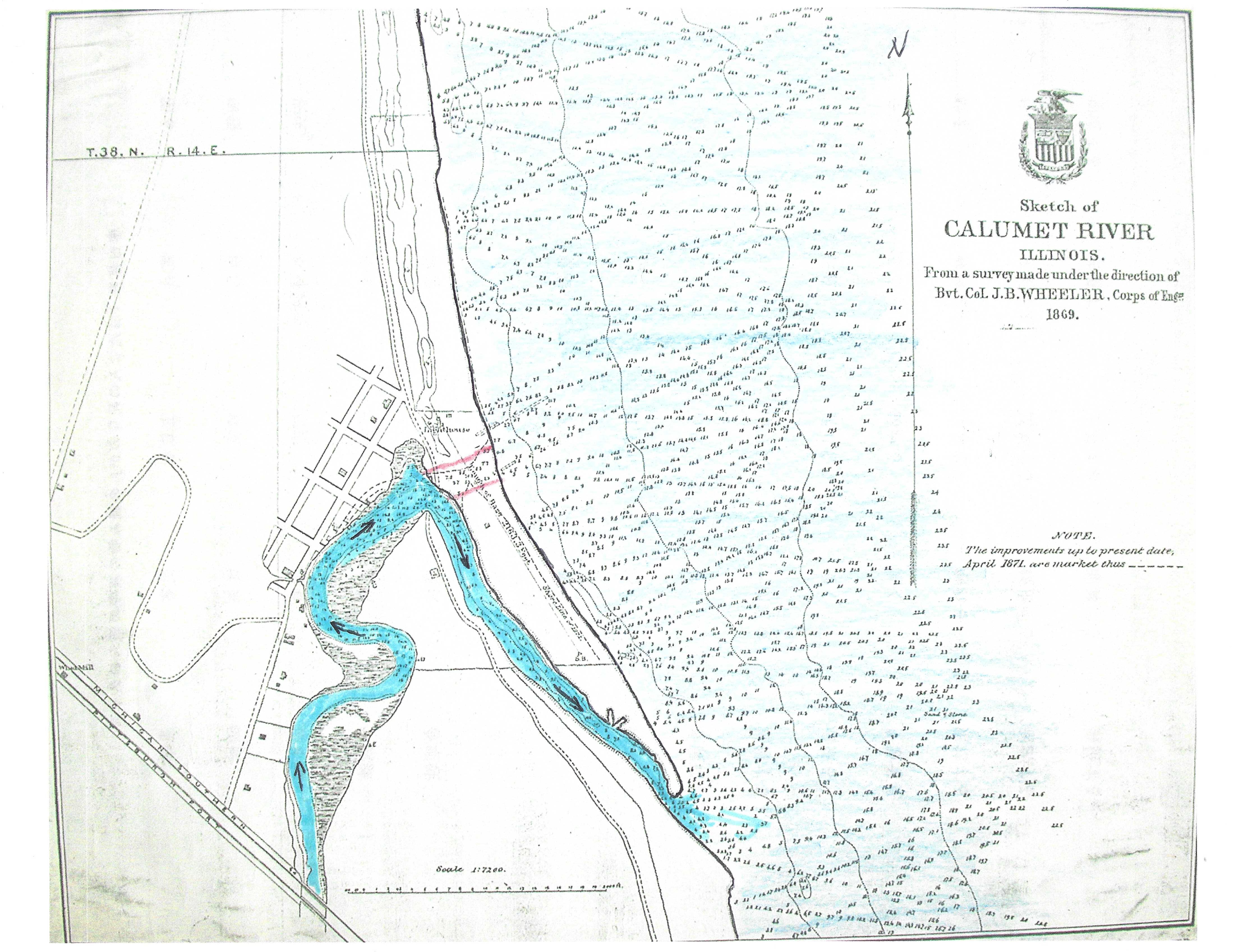
In July 1870, the Calumet and Chicago Canal and Dock Company lobbied Congress successfully for legislation that provided $50,000 to improve access to the Calumet River and harbor. The first step was to straighten the river’s egress to Lake Michigan. As the map above shows, in 1869 a large sandbar diverted the river southeast for almost a mile before it found its way to the lake. At approximately the location marked by red lines on the map, a channel was cut to allow ships direct entry to the river. The river was then deepened and widened, and the mud dredged from the bottom of the river was used to extend the shoreline and raise the flood-prone land beside the river. Two piers were built, and by 1873 South Chicago had become a port of entry.
Industry was ready to move in. The Calumet River area offered big industry a wide open escape from the ever more claustrophobic conditions of the city of Chicago. In 1875, the first steel mill in the region, the Joseph H. Brown Iron & Steel Company, began construction of their plant on the west bank of the Calumet at what is now 109th Street. The company eventually became Wisconsin Steel, which operated on that site for 105 years until it closed in 1980.
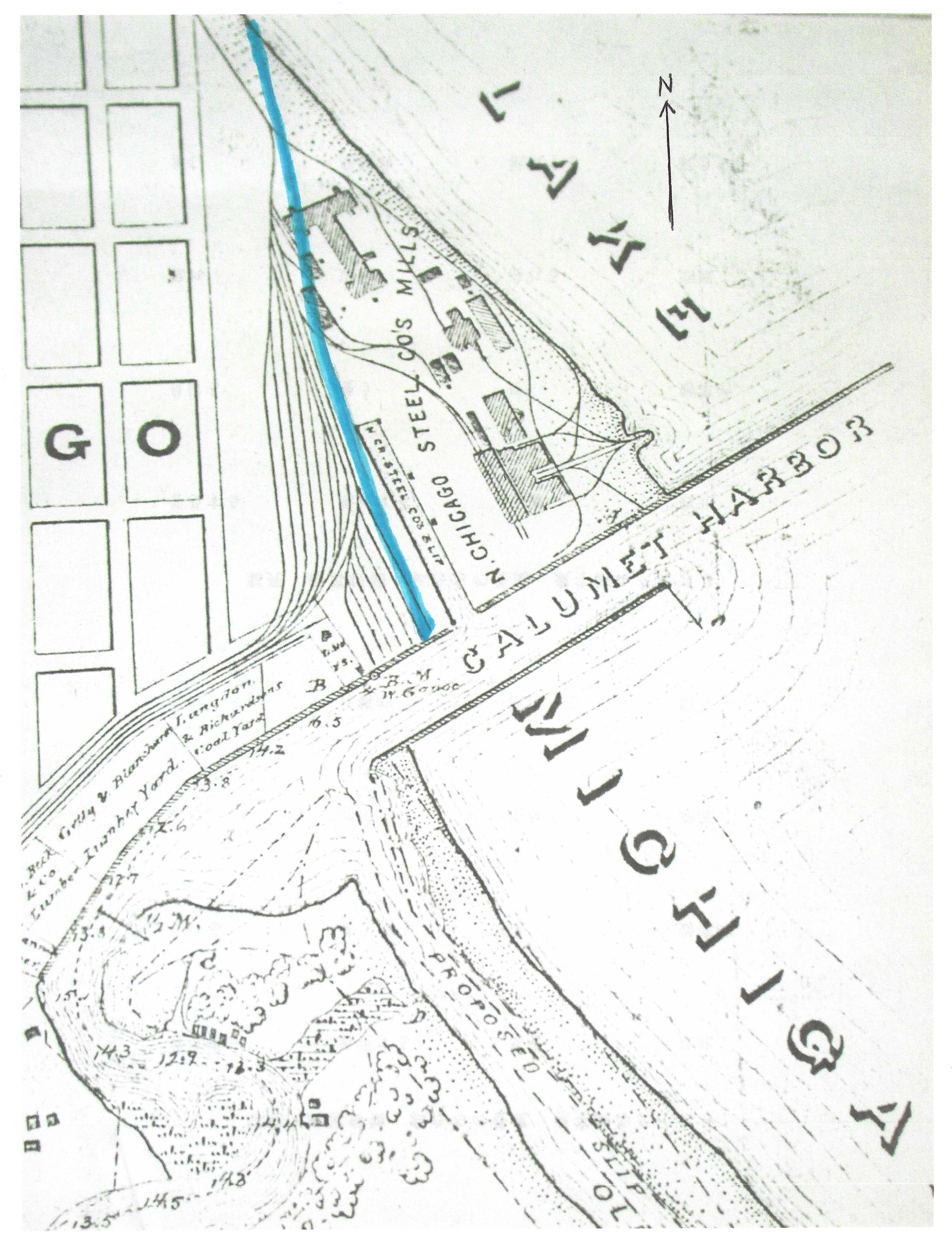
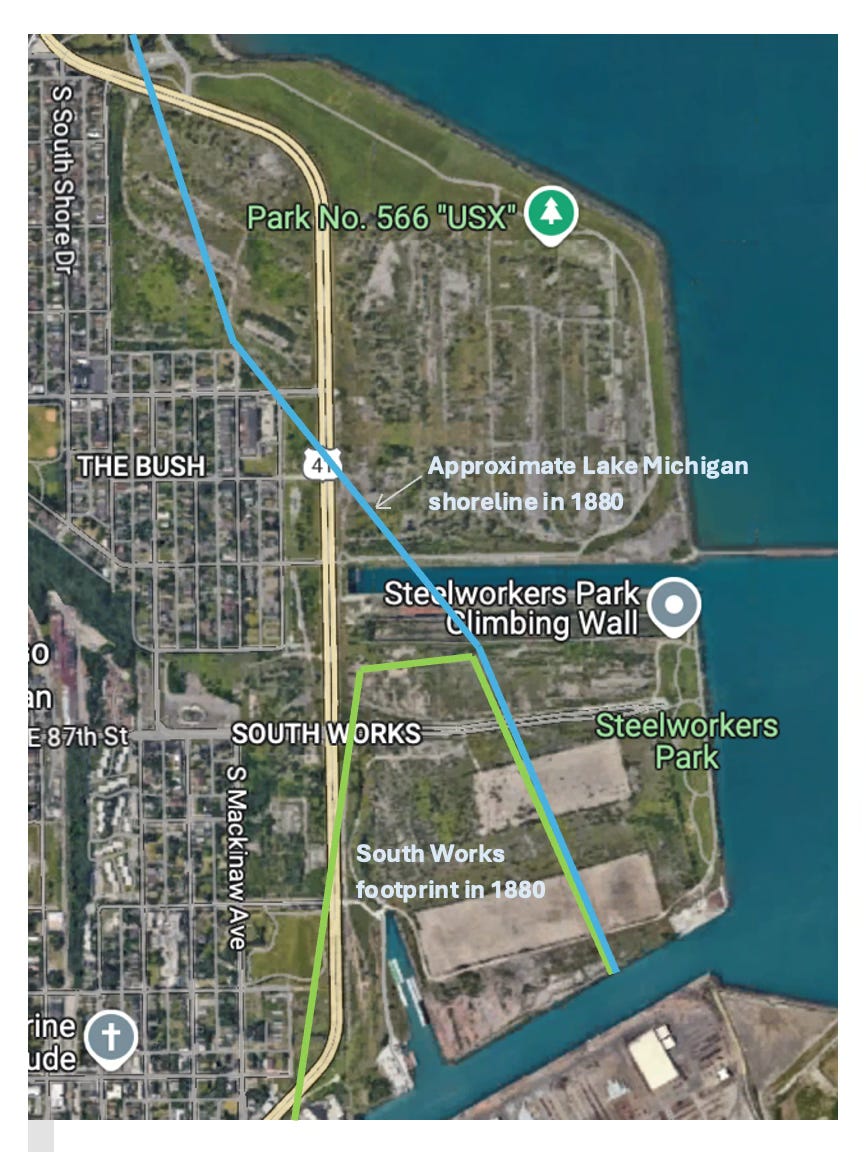
As Orrin Potter’s North Chicago Rolling Mill was gradually being surrounded by the ever expanding metropolis of Chicago, he saw the Calumet River area as the ideal place for a larger, integrated plant, where he could smelt iron, make steel and roll rails all in one location, unencumbered by a city hall complaining about noise and pollution. In 1880, on the north bank of the Calumet, he procured 73 acres—1,500 feet of frontage on the Calumet River and 2,500 on Lake Michigan. Almost this entire area was landfill, comprised of river sludge and industrial waste that was dumped there between 1869 and 1880 by companies like Wisconsin Steel. The blue line on the map below shows the approximate location of the Lake Michigan shoreline in 1869. In 11 years, the shoreline was pushed a quarter mile east out into Lake Michigan.
On March 22, 1880, Orrin Potter broke ground on the plant that was called the North Chicago Rolling Mill – South Works. The plant would go through various owners in its long history—Carnegie Steel, Illinois Steel, US Steel, to name a few—but regardless of who owned it, the plant was always called South Works.
Construction of the new plant went quickly, and within one year almost to the day—March 26, 1881—South Works blasted its first pig iron. Those who had gathered for that first firing were led to a small workmen’s shed where they could view Potter’s plans for the use of the site. There would soon be two more blast furnaces, three Bessemer process converters for turning the pig iron to steel, and of course a rolling mill.
Potter was on a roll. On June 14, 1882, fifteen months after the first firing of the mill’s blast furnace, the first steel rail rolled off the line at South Works. The die was cast, and from here began the modern history of Park 566.
Between 1882 and today much water would flow under the bridges over the Calumet River before Park 566 would come to be. In fact, much water would flow over Park 566 itself, because in 1882 Park 566 was underwater. Not for long.
In a future episode I will write about the Anthropocene glaciation that led to today’s Park 566.
Sources
US Steel: 75th Anniversary Booklet, c.1955
“The Bayview Historian,” Volume 2022, No. 2
Southeast Chicago Historical Society Archives
Chicago’s Southeast Side Industrial History (Revised March 2006), Rod Sellers, Southeast Historical Society
Thanks so much for digging into the history of South Works and sharing it in this way, Dan. I particularly liked your statement “we get what we want, and we lose what we need.”