
How Do You Say "Scaup"
Greater or Lesser, they're more or less the same

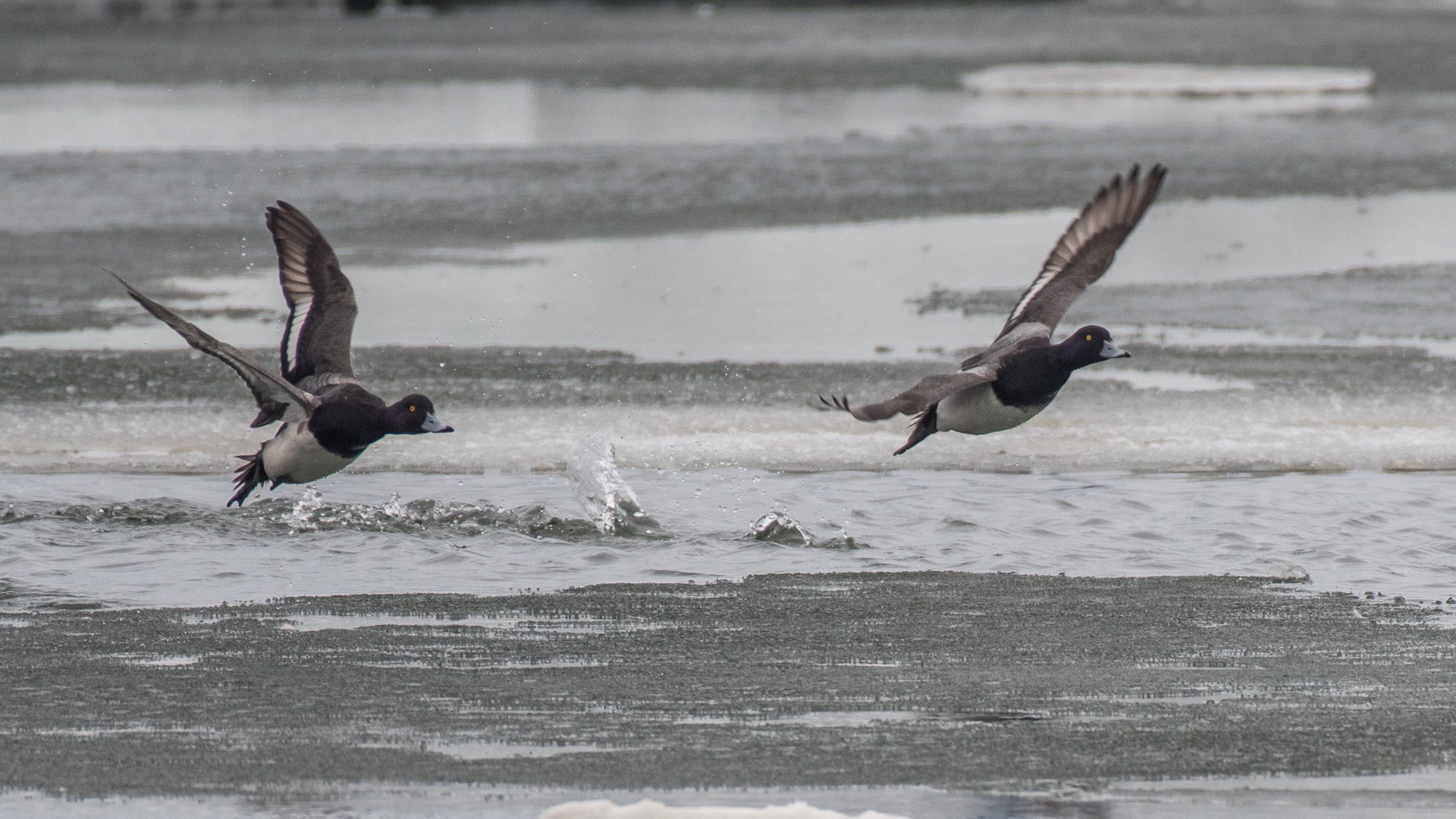
Today I can kill two birds with one stone.
Wait. That’s not the best choice of analogies to launch an essay on birds. Maybe “Free two birds with one key?” Or, sticking with a stone/rock analogy, how about “Film two Rocky movies with one Stallone.”
I think I’ll change gears completely and go with an ice cream theme: Serve two scaups in one cone.
The poor birds still do not make out well in the end, but the analogy works because—I am convinced—no one really knows how to pronounce the name of these birds. Here in the Chicago area I often hear scaup rhyming with “cop,” pronounced as only a Chicagoan can say it. I’ve also heard some people pronounce it like “scope,” while others say it like the “aw” of “awful.” When I Googled “pronounce scaup,” I found a recording by a guy—he had to be a Scotsman—who pronounced it like what you would put in an ice cream cone.
Anyway, today’s twofer deals with closely related waterfowl who are stalwart regulars to the Chicago winter lakefront—the Greater Scaup and the Lesser Scaup. I’ve already written a piece on the Greater Scaup, and I do not want to repeat myself, but the Lesser Scaup deserves its day in the sun. And whether I like it or not, it is next to impossible to talk about the Lesser Scaup without comparing it to the Greater Scaup. So I will cover them both again in—to use another avian analogy—one fell swoop.
Let’s begin by getting the comparisons out of the way. Lifestyle: Both the Greater and the Lesser Scaup are diving ducks, foraging for crustaceans at the bottom of shallow lakes and bays. Dress: In plumage they are almost identical. I’ve heard both birds described as Oreo cookies: black on both ends, and whitish in the middle. Their blue-ish colored bill earns them both the nickname bluebills. Size: As its diminutive name indicates, the Lesser Scaup is ten to fifteen percent smaller—in length, weight and wingspan—than its slightly chunkier cousin. All of this adds up to two very similar looking species that create a serious ID challenge for most birders.
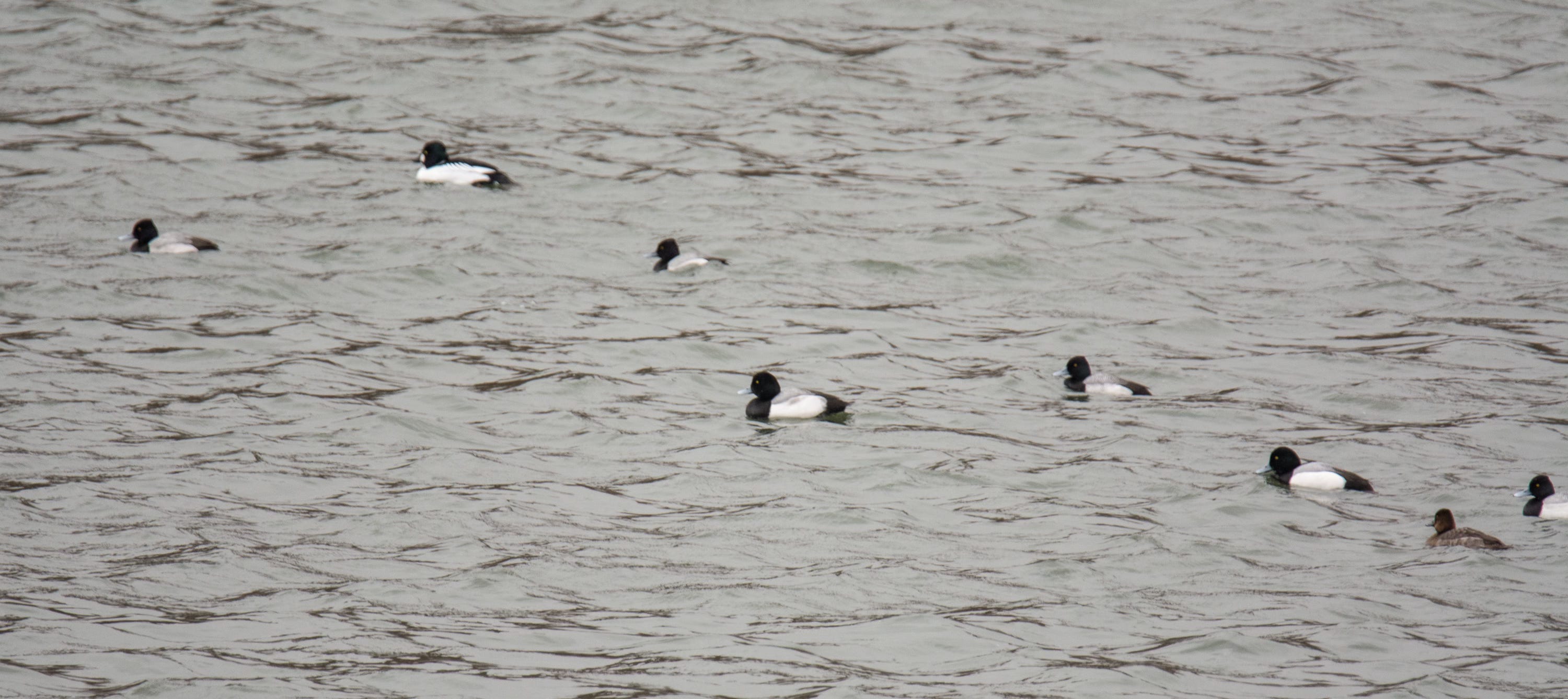
So, when you see a group of scaup floating on a body of water, how do you know which you are looking at? Their plumage is the same, and as they bounce up and down on the waves, a ten percent difference in size can be very difficult to gauge, even if it is a mixed flock. One surefire way to know that all the scaup you see are Lesser Scaup is to visit Costa Rica in winter. Those Oreo cookies floating on the lake that your hotel overlooks? You can be sure they’re all Lesser Scaup, because among all the related North American ducks in the genus Aythya—Greater Scaup, Redhead, Canvasback, Ring-necked Duck, Tufted Duck—only the Lesser Scaup winters so far south.
Another way to know you’re looking at Lesser Scaup is to vacation in the treeless tundra wetlands of northern Canada in late spring. As you lounge in your floating lawn chair, swatting away hordes of mosquitoes and black flies and sipping your cold Molson, keep a close eye on the hundreds of nesting Greater and Lesser Scaup that surround you. When a Greater Scaup chick hatches, it will sit still for several hours until its downy feathers are dry. Then it will rest quietly on the nest for the first 24 hours or so, before eventually making its way into the water.
But it’s Lesser Scaup you’re looking for, so never mind those dilly-dallying Greater Scaup chicks. Look instead for the nest where every chick acts like the second child. After the hatchlings emerge from the eggs, their down has barely dried before they’re jumping out of the crib into the water, where they immediately begin testing their diving skills. This would be the nest of a Lesser Scaup. The chicks can’t dive very deep, or stay under for more than a few seconds, because all that fluffy down makes them far too buoyant. But that doesn’t keep them from trying. I’ve never seen this with my own eyes, but just the thought of a frazzled looking mother Lesser Scaup trying to corral a dozen fuzzy ping-pong balls disappearing underwater and boing-boinging back up again all around her puts a smile on my face.
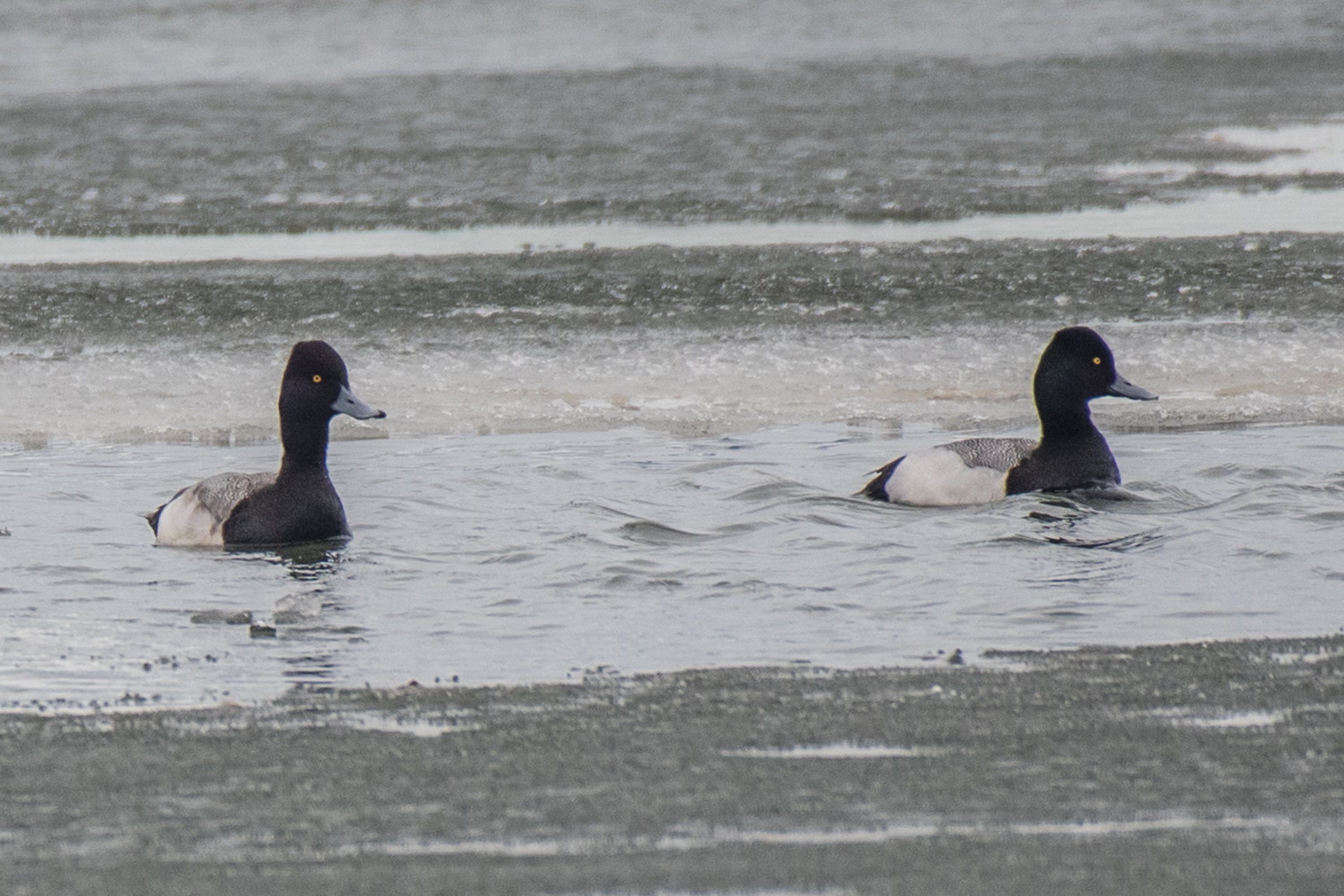
Of course, there are less expensive ways than traveling to Costa Rica or northern Canada to tell whether you’re looking at a Lesser or a Greater Scaup. The shape of the head and the amount of white on the flight feathers are the two key field marks; I’ll leave it to you to consult your favorite field guide for the details. In the meantime, under my breath so my birder friends can’t hear me, I’ll offer you another approach to scaup ID: Don’t worry about it.
As you watch a raft of a hundred scaup floating on Lake Michigan, shimmering marvelously in the morning sun when they resurface after each foraging dive, you face an existential dilemma: How important is it to you to be able to tell the Lesser from the Greater? Unless you are a serious birder looking to expand your year list and contribute complete and accurate data to Cornell’s eBird database, maybe it’s enough just to know they are scaup. Leave it at that, and enjoy the beauty of the moment.
Now, if a group of birders happens by while you are watching the scaup, listen carefully while they try to suss out an ID—and a pronunciation—for all the birds in the flock. “They seem to be mostly Greater Scopp,” says one birder. Another adds, “I count twenty-two Lesser Scope,” and the whole group eventually agrees it’s a 30/70 mix of “Lesser Scawp” and “Greater Scoop.” When you decide you’ve heard enough, put on your best Scottish accent and declare, “Haud yer wheesht , an get oan wae it, ye numptys! It’s justa wee treud de Scoop.” The birders will move on soon enough, and you can go back to humming “What a Day for a Daydream…” while you enjoy the moment.


Dan, I did not know that you had a Substack until Kelly reposted something you wrote, and you made me laugh out loud multiple times. I'm SO excited to subscribe. I hope to get back to 566 and explore with you and Kelly again soon!
Or cynically, just need one each clearly identified lesser and greater scaup in early January, then the rest of the year scoops/scaups//scawps they are. Great fun read and photos.